Lorem ipsum dolor sit amet, consectetur adipiscing elit. (Sed )do eiusmod tempor incididunt ut labore et dolore magna aliqua.

X

Type your keyword below

9 Benefits of Technology and Its Effect in Adapting the Education System of Present Generation

Education is not limited to blackboard nowadays. With the advent of the digital revolution in the 21st century, every organization every department is moving towards digitization.

Technology has made many tedious tasks into more streamlined and smooth work. In education also technology is playing many roles to make education more modern, more aware, informed and updated. There are many software and programmes which are making the education system more collaborative and synchronized. Academia ERP is one of the leading education management programs that is making handling and managing many education systems easier and efficient.

There are many benefits of using technology in the education system in the present generation. I am listing here the top 9 benefits of the technology in the education system.

1. More Resourceful education

Previously there were limited resources to gain knowledge about a particular topic. And if anyone wanted to dig deep in any topic he/she had to go through thousands of books, paper, research work to gather the information.

Today it is not like that; Whether you are a grad student or primary school student or teacher, you can get tonnes of information within seconds for the topic you want to know. Education has become more resourceful with the help of technology.

2. Tedious tasks have become easy

Keeping the record of student attendance, fees, homework, examination, and everything required tedious manual work of hours. It was time-consuming and hectic. With technology like Academia ERP, it has become easier than ever. Keeping the record of everything is simple, smooth and systematic. An Education management system i.e. Academia will ease out your processes and make institutional life simple.

Academia- leading-edge education management software” has already started working on AI chatbot which will help the institute with auto-generated answers for the queries of the users and make system effectively efficient.

3. Fresh Information

With technology student and teachers, both get the newly updated information. The world is changing a lot and there are new researches, new invention going on every day. If you want to move with the world you have to keep up with this. Technology helps the education system to move with the world. They can find fresh information about every topic they want.

4. More collaboration in the classroom

New tech always attracts everyone. With new technology and gadgets, it has made the classroom more collaborative. The students and teachers can connect in a more effective manner that increases the exchange of knowledge easier.

5. More experiments than theory

Experiments make the learning foundation strong, this is a fact. When student experiment the topic they learn it increase the comprehensive understanding of the student.

With the use of technology understanding and skills of students and teachers both have reached a new level.

Through an ERP solution i.e. Academia, Teacher & student can interact more easily and effectively.

6. No more burden of heavy books

Different book for a different subject, different notebooks for different homework.

Not anymore!!

With the use of technology, hard copies of books are becoming obsolete. They take more space and difficult to handle many books at a time.

Internet and mobile/laptop/tab has helped the student and teachers to reduce the burden of all these papers and books.

7. Technology is a necessary life skill today

Use technology is not a fashion now it is a necessity. It is a life skill to stay forward in the world, to be updated in the world.

If you are aware of how to and where to look to get certain information you are already ahead of 50% in your work.

An education system with technology is a complete structure for student and teachers and management.

8. Technology has changed the relationship between teachers and student

Teachers and student relationships are changing and it is more simplified now. They connect more effectively. The exchange of information is better, effective and comprehensive.

9. Full participation and more fun way of learning

Online poll and feedback of assignment have made the student participate more in the learning. Data analytics and education software have made the teachers/professors find out where the students are lacking so that they can change the classroom program accordingly.

Technology has made education more fun and interesting. As the interaction and knowledge are not limited to simple blackboard drawing. Students are learning in with more focus and with more efforts.

On concluding note:

The education system is what changes the future of the world and technology is helping to make this change in more faster, more efficient and more powerful ways. Present generation very aware of its needs and requirement. There are more Elon Musk, Mark Zuckerberg ready to roll the world. Technology in education is a system is benefiting this generation to reach new goals.

For the bottom line, Academia is the right solution to overcome challenges and success in managing your institute. We provide systems with the right cost that fits your pocket and benefits you enormously once implemented. Academia Provides the best support in the industry. (Look at the client testimonials, how: https://www.academiaerp.com/clients/). We provide training programmes off site and on site as per the institute’s requirements.

Are You Looking For Right Education ERP?

Buying an ERP is still being the biggest problem for organizations and especially for education institutes. There’re only a few good options available in the market for education ERP. It is important to take the right decision since buying an ERP is a very time consuming and expensive decision that would last for a really long time. And making mistake in such a decision is irreversible.

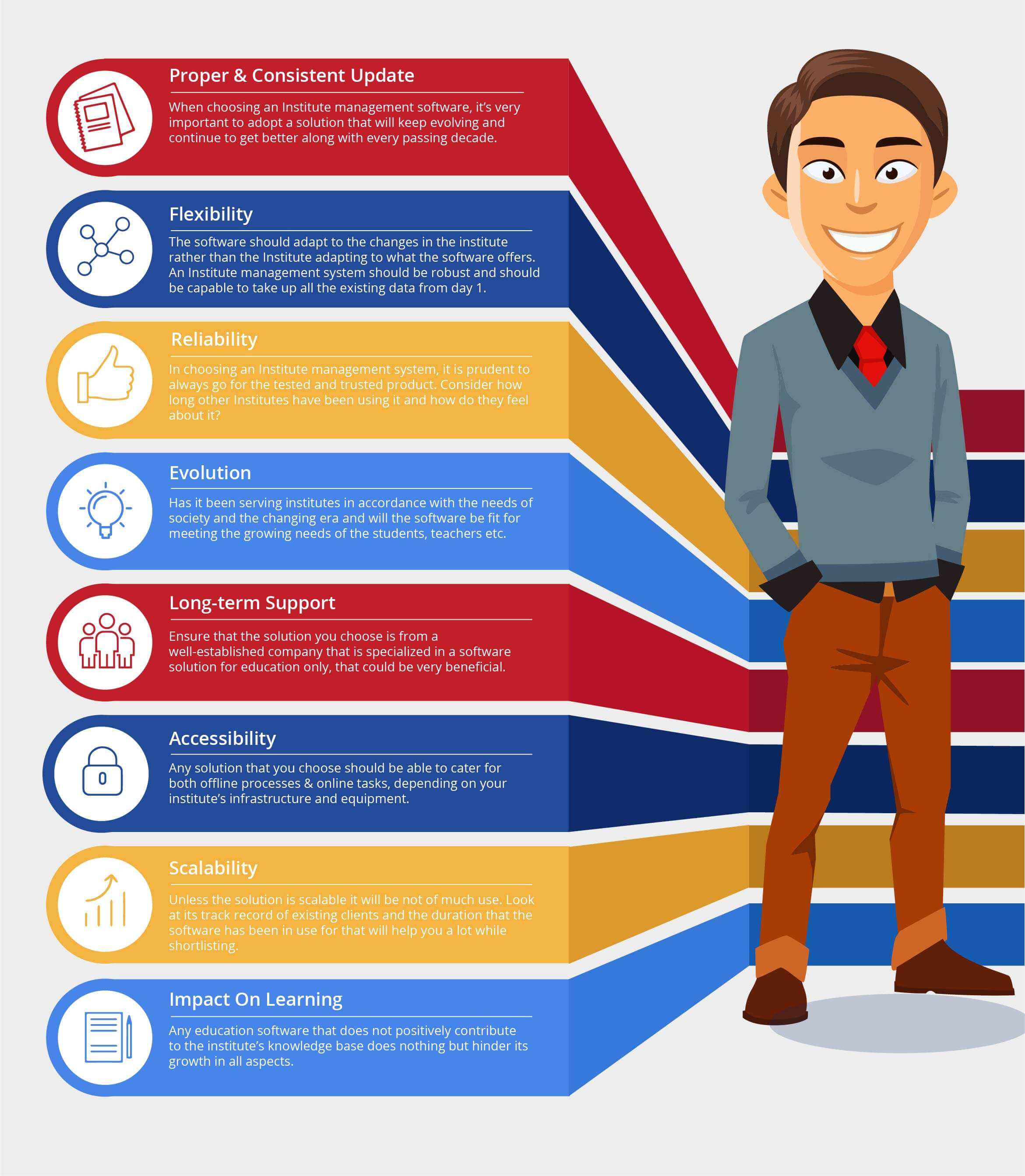
Consider these important factors while buying an ERP solution for your Institute:

  • Proper & Consistent Update: When choosing an Institute management software, it’s very important to adopt a solution that will keep evolving and continue to get better along with every passing decade.
  • Flexibility: The software should adapt to the changes in the institute rather than the Institute adapting to what the software offers. An Institute management system should be robust and should be capable to take up all the existing data from day 1.
  • Reliability: In choosing an institute management system, it is sensible to always go for the tested and trusted product. Consider how long other Institutes have been using it and how do they feel about it?.
  • Evolution: Has it been serving institutes in accordance with the needs of society and the changing era and will the software be fit for meeting the growing needs of the students, teachers, etc.
  • Long-term Support: Ensure that the solution you choose is from a well-established company that is specialized in a software solution for education only, which could be very beneficial.
  • Accessibility: Any solution that you choose should be able to cater to both offline processes& online tasks, depending on your institute’s infrastructure and equipment.
  • Scalability: Unless the solution is scalable it will be unusable or rather say not of much use. Look at its track record of existing clients and the duration that the software has been in use for that will help you a lot while shortlisting.
  • Impact on Learning: Any education software that does not positively contribute to the institute’s knowledge base does nothing but hinder its growth in all aspects.

Are You Looking For Right Education ERP- Read here some important factors while buying an ERP solution for your Institute-Academia ERP

6 Steps To Perform Student Enrollment Management In Higher Ed

Enrollment management refers to the ability of institutions of higher education to exert more systematic influence over the number and characteristics of new students, as well as influence the persistence of students to continue their enrollment from the time of their matriculation to their graduation. The emergence of enrollment management as a new administrative structure within institutions of higher education originated in North America, but it has also been employed in Europe, Africa, and Asia.

The Concept

Enrollment management can be viewed as a synergistic organizational concept that can be used to link several administrative functions within a college or university in order to optimize institutional enrollment goals. Examples of this approach can be found among the financial strategies of many college campuses, where important linkages have emerged between senior enrollment managers and chief financial administrators. Both private and public colleges use some of their tuition income to fund campus-based scholarships for students. Tuition revenue accounts for millions of dollars, and campus-based financial aid has become a large expenditure at most four-year institutions. Enrollment management efforts have therefore become closely linked to budgeting and campus financial planning. Successful enrollment management strategies and practices must also consider the growing importance of university and college rankings. For many institutions of higher education, enrollment management has come to involve a combination of student enrollment strategy, budgeting strategy, and institutional positioning strategy.

Roadmap

1.  Set goals for enrollments

Setting up realistic goals and working in that very same direction to achieve them is the first necessity of systematic enrollment management for an institute. It is a crucial step since it involves market analysis and calculation of the expected rate of growth.

2.  Resource requirements

To identify the need for the required resources according to the set goals is the next step in the roadmap for enrollment management.

3.  Campaigning and recruiting plan

It is important to create a target focused marketing plan for move in the right direction and reach the set goals. The right kind marketing mix may help you get to the right target audience which would ultimately help us meet enrollment management goals.

4.  A strong follow-up on your marketing and recruitment activities

Tracking your activities is a must in the process of enrollment management to get the results. Following steps can be followed to keep on a regular check on these activities:

1) Identify which metrics to track.
2) Know how to track the metrics you identified.
3) Guide your decisions with the data you collect.
4) Monitor the effect of your efforts and adjusting accordingly.

Having a solid set of marketing and recruitment metrics you can track allows you to benchmark your efforts from year to year and make crucial decisions on allocating resources and strategies.

5.  Systematic communications within the process to develop and implement the right strategy.

With the seemingly chaotic mix of print, e-mail, Web, and social media, there may not seem to be much “flow” with recruitment communications. As with student qualification, though, building a communications flow remains a bountiful recruitment strategy if it is handled strategically.

First, you still must think through the communications at various enrollment stages—inquiry, applicant, admit, deposit. Regardless of where a student enters the flow, progressing them to the next enrollment stage remains the goal.

Second, focus your electronic communications wisely. Having a Web site that engages students is paramount. You want to invite communication in addition to delivering information. Give students opportunities to provide their e-mail addresses or even opt in to text messaging. Do the same with social media but be careful not to go overboard. You are better covering fewer social media outlets well rather than spreading yourself too thin.

Finally, get parents and guardians involved in the flow. According to our E-Expectations research, 60 percent are involved with the college research process. Target them with communications and make them ambassadors for your campus.

6.  Award financial aid so students get what they need and expect to enroll

The ability to afford a college education has emerged as the biggest roadblock to attending college. Perhaps nothing will turn away a prospective student faster than a feeling that they cannot afford your institution. You must address this concern immediately and accurately.