Lorem ipsum dolor sit amet, consectetur adipiscing elit. (Sed )do eiusmod tempor incididunt ut labore et dolore magna aliqua.

X

Type your keyword below

Top 6 Functions of Student Information System that Every Educator Should Know

A well-implemented Student Information System transforms institutional operations and empowers educators to focus on what truly matters—teaching and learning. From managing student data to enhancing communication and improving academic performance, the benefits of an SIS are undeniable.

investing in a robust SIS is no longer optional—it’s essential for institutions aiming to embrace digital transformation. Educators who understand and leverage these six key functions can drive better results for both students and the institution.

1. Student Data Management

The core function of any SIS is efficient student data management. From personal details and admission records to academic progress and health information, the system securely stores all data in one place. Educators can easily access student profiles, track performance, and make informed decisions.  Teachers can tailor their teaching strategies based on individual student needs, ensuring a more personalized learning experience.

Key Features:

  • Centralized student profiles with demographic and academic details.
  • Secure storage and easy retrieval of historical records.
  • Real-time updates for any changes in student information.

2. Attendance Tracking

Every contemporary SIS will have an attendance module. The system allows educators to intervene early if a student is frequently absent. Teachers can mark attendance within seconds, while administrators get real-time reports to identify patterns and address absenteeism. An SIS automates this process, making it efficient and accurate. 

Key Features:

  • Daily and subject-wise attendance marking.
  • Instant alerts for absenteeism.
  • Detailed attendance reports for each student.
  1. Marksheet & Assessment Management

Grading and assessment is a complex process, especially when dealing with multiple subjects and exams. An SIS simplifies this by providing integrated marksheets where teachers can enter scores, calculate final grades, and share results with students and parents. Educators can easily identify students who need extra support while parents stay informed about their child’s academic progress.

Key Features:

  • Customizable grading scales and weightage.
  • Automated report card generation.
  • Performance tracking over time.
  1. Timetable & Scheduling

A timetable can last for six months or more. Creating timetables for classes, exams, and extracurricular activities can be challenging. An SIS automates this process to ensure efficient resource allocation and conflict-free scheduling.

Key Features:

  • Automated class and exam timetables.
  • Schedule adjustments with instant notifications.
  • Resource management for classrooms and teachers.

5. Communication & Notifications

Effective communication between institutes, teachers, parents, and students is essential for student success. An SIS bridges this gap by providing multiple communication channels.  Transparent communication ensures everyone stays updated, reducing misunderstandings and enhancing collaboration.

Key Features:

  • Real-time notifications for attendance, grades, and events.
  • Two-way communication between teachers and parents.
  • Event and exam reminders.

6. Reports & Analytics

Data-driven decision-making can transform education. An SIS provides powerful reports and analytics to help educators identify strengths, weaknesses, and opportunities for improvement. Educators can make proactive decisions to ensure better learning outcomes and efficient college/university management.

Key Features:

  • Customizable reports for academics, attendance, and behavior.
  • Visual dashboards for quick insights.
  • Predictive analytics for academic performance.

Conclusion

Efficient student data management is not just about organization—it’s about empowerment. It equips educators with the tools to provide personalized learning, improves institutional efficiency, enhances communication, and drives long-term success. In an era where data drives progress, institutions prioritizing effective student information management will deliver quality education and foster institutional growth.


How Student Registration Software Simplifies Admission Process?

Admissions, The most primary and important task for any institution! True? Every institution always looks forward to bringing the best and brightest students according to their fixed requirements. It is the time when institutions need to do various tasks that ultimately are responsible to bring the right candidates, and thus educational institutions put their utmost efforts to perform the admission process effectively. Do you want to make the admission process more simpler and effective in your institution? If so then student registration software can be one of the best options for you. 

What step does your institution take to complete an error-free, effective, and efficient admission process?

Management, as they say, is the art of getting work done tactically through the efforts of other people. Management is universal and all-pervasive. However, it has an extremely critical role when it comes to the Education sector. The education sector has expanded leaps and bounds. With the booming population, this sector is gaining grounds both for the students and for academicians. When it comes to managing an educational institute there are several complexities and vagaries that the educational institution has to face.

Let’s discuss how admission management can reduce various roles and responsibilities by changing the overall functioning of admissions in institutions.

Why should you opt for a student registration and admissions management system?

The student registration and admission management system is something that helps the colleges and schools to manage the overall process simply and efficiently. If you are looking forward to an automated, simple, and less time-consuming admission process, then a student registration and admission management system is the only best option you can opt for. Check out the below reasons to understand more about it.

Reasons to choose a student registration software:

  • Automation 

Institutions opting for student registration software and admission management systems can access a simple and automated version of their workings, using it you will not need to spend time collecting the forms, sorting them, and not even documenting the forms. The student registration software can do all the processes easily and effectively. Automation of the process will also help in finding and sending the acknowledgments, and making receipts as per the requirement.

  • Error-free and simple process 

Suppose a school is still following the traditional method for admission and a student filled incorrect information in the form, in this case, the management can never able rectify the error in any case, they just have the option of rejecting the admission of the student or calling the student to rectify the error, but if the same school is having a student registration software, the system will alert the student or his parents about the incorrect information or blank space. It not only helps in making the process error-free but also makes it much simpler and easy to access. 

  • Time-saving process 

Student registration and admission management system can help the institution, as well as the students/parents, save a lot of time. Students/parents will not need to wait queuing for long to collect and submit their admission forms, meanwhile, the management will also get the opportunity to complete all the processes with just a few clicks.

  • Reduces mental stress

Admission season is one of the most important time for any educational institution, so at this time the management and faculties put all their efforts to manage the admission process, but in all this, the management and faculties have to face various kinds of issues due to the long and complicated traditional education system resulting in mental stress for them, it directly affects the process bringing various errors and chaos.

Although, if your institute owns a student registration and admission management system they can automate the complete process simply and systematically reducing the paperwork and ultimately the mental stress of the manpower of your institution. 

  • User friendly 

Using an online admission process you get a bunch of advantages that we have discussed above, but most importantly a student registration and admission management system is user-friendly that eventually helps in making the complete admission process simple, effective, and worthy.

Read our latest case study of Thiagarajar School of Management

Examination Management System Case Study

Why is Academia’s student registration and admission management system the best choice for you?

The student registration and admission management system designed by Academia is completely made to simplify and automate the entire admission process, it includes all the aspects that you just need to follow a smooth and proper admission process in your organization. Your institution can manage the smooth functioning of student admission forms, student fee receipts, scholarship receipts, managing the details of students for the long run, creating a unique username for the student, automation of attendance after the admission, batch allotment, proper records of academic years, and many more

Sounds interesting! Book a free demo now to learn more about the student information system by Academia from our team of experts. 

Top 10 issues around school management and how to solve them easily with ERP

We all are aware of the fact that technology is here to stay and transform. But when it comes to answering how specific it is in solving the challenges unique to you and your institute, you may find yourself wondering. 

Answering the same questions for you, here is how education ERP solutions such as Academia ERP solve some of the biggest challenges of a school. For any further information, do feel free to connect with our technology experts. We are sure you would love what you see in the live demo. 

Common challenges in School Management:

  • Paper-bound processes

Let’s just say, that you are trusting your employees to care for every single paper that is running across various departments and save it for further reference – you have too much faith in people and you are bound to see some serious mismanagement. 

The world is moving at the speed of light, people are loving digital operations. Needless to say, your employees need to access the information fast, speed up every single operation and maintain pristine records of everything that is happening in your school. And this would happen when you have a digital system in place. A software that would automate repetitive processes, and track every piece of information for you in seconds. 

  • Student/parent experience

The negative experiences of students and parents may be bad for your school’s reputation. Students and parents do not love to stand in a queue for hours for meager things such as getting a form or paying their fees, or asking for some information. 

You can simplify all this with an education ERP that would send out forms to their mobile or web apps, and provide seamless communication through SMS or push notifications on their devices. Reminder emails and notifications would eliminate the need for a person to roam from classroom to classroom to inform people about the ongoing activities in a school. 

  • Admissions and Enrollment 

It would not surprise you if we say, you are losing out on a large volume of applications each year just because you don’t have a system to manage the enquiries. In a competitive environment such as now, you should not give any chance to your competitors to thrive on your shortcomings. 

With an efficient education ERP you can fill these small gaps in your processes and ensure applicants are getting the right information and have all the aid they require throughout the admission process. Admissions and enrollment process thus can be digitalized through education ERP and shoot up your admission rates by several folds. 

  • Course Management

Designing a course curriculum is an every-year activity and a process that is time-consuming and labor-intensive. With the course management system, you can accomplish this task much easier and in a very short period of time. Also, regulations around curriculum and knowledge resources have become very strict. The regulatory bodies want to ensure students have access to quality education. 

Hence, course management activities such as creating a curriculum, and managing resources, assignments, and examinations should be in line with these policies and regulations. An education ERP would offer you the ease to support the goal of graduating students having near-zero instances of shortcomings in course management. 

  • Teacher Evaluation

Not only is it important to evaluate student performance but teachers too should regularly be evaluated based on student performance and success. Since generating reports on performance for a big number of teachers in your institute is difficult, go for an education ERP. The software comes with a number of reports that gives you granular reports on every teacher’s performance.

  • Communication and Collaboration

Not many institutes pay much attention to this challenge but this is maybe one nail that is stopping you to attain a top speed in your operations. Lack of communication between various departments, and lack of communication between students-teachers / student-teachers-parents can result in operational gaps. Seamless flow of information in real-time thus increases collaboration between departments and ensures higher experience for your all stakeholders. 

  • Classroom management strategy

Schools are not only responsible for academic education but they are responsible for building a good character in a person. Infusing qualities such as punctuality, honesty, discipline, and more are the primary goals for schools. Hence, a classroom management strategy that ensures close monitoring of students’ behavior and participation in the classroom is important. With an education ERP, you can get a robust discipline tracking and behavior management system for making this process more effective and streamlined. 

  • Student Monitoring

Teachers are struggling to monitor student activities, this includes attendance, leave, discipline, assignments and so much more. School administrators build students’ results based on these reports. The more effective the monitoring system is the more closely it would analyze a student based on these aspects and hence, provide a more clear report on a student. 

Automating and streamlining student attendance, assignment collection, and behavior management would give administrators a real-time status of any student’s activity and allows them to build performance improvement strategies. Since education ERP software offers you all these tools, it is very practical to have one for your institute. 

  • Revenue Management

Tracking every transaction in your institute with a paper-bound system is not going to ensure the best revenue management. The robust education ERP system allows you to get real-time updates on every transaction and offers online payments securely. This means, you now have a hawkeye over every monetary transaction happening in your organization on implementing education ERP. 

  • Forecasting the academic achievements

Statistics and data have transformed the world. It gives you the ability to peek into the future and change its course with effective strategies in the present. A predictive analytics tool is one of the biggest benefits you get from implementing education ERP. 

A product such as Academia SIS/ ERP comes with an AI-based data analytics toolset that provides predictive analytics on the academic performance of the students. Hence, you can know the outcome of a student’s performance before it has appeared in an exam and work on their weaknesses to alter the results. This gives you one added benefit and a sharper edge in the market to guarantee top-notch academic results. 

Concluding

Education ERP for Schools aims are automating all your processes while acting as a centralized database to support all the departments and their operations. Features such as real-time information access, remote access, remote functionality, predictive analytics, reporting, and resource management allow you to streamline processes and ensure faster operations. 

An ERP Promise to Profitability in 5 Simple Steps

With an ERP solution comes a great promise: the potential to help your organization (Institution) make more money while spending less. Whether or not you already utilize ERP technology, profit is the engine that drives business. An ERP solution can steer your company in the right direction by helping you make more profit. Academia ERP is an advanced ERP solution with an amazing support system that can help institutes get there.

The Basics:

The ERP solution itself can’t guarantee success. You and your company must guide the ship, using ERP as the sail. The promise of ERP can be fulfilled, but you must look beyond the software to find the formula that will lead you toward increased profits through smooth functioning and improved operations. Academia ERP helps you in increasing your overall profits by decreasing manual intervention in the processes and increasing the rate of admissions per year by removing inefficiency barriers from the processes.

Power of People + Power of ERP = Increased profit and a healthier organization.

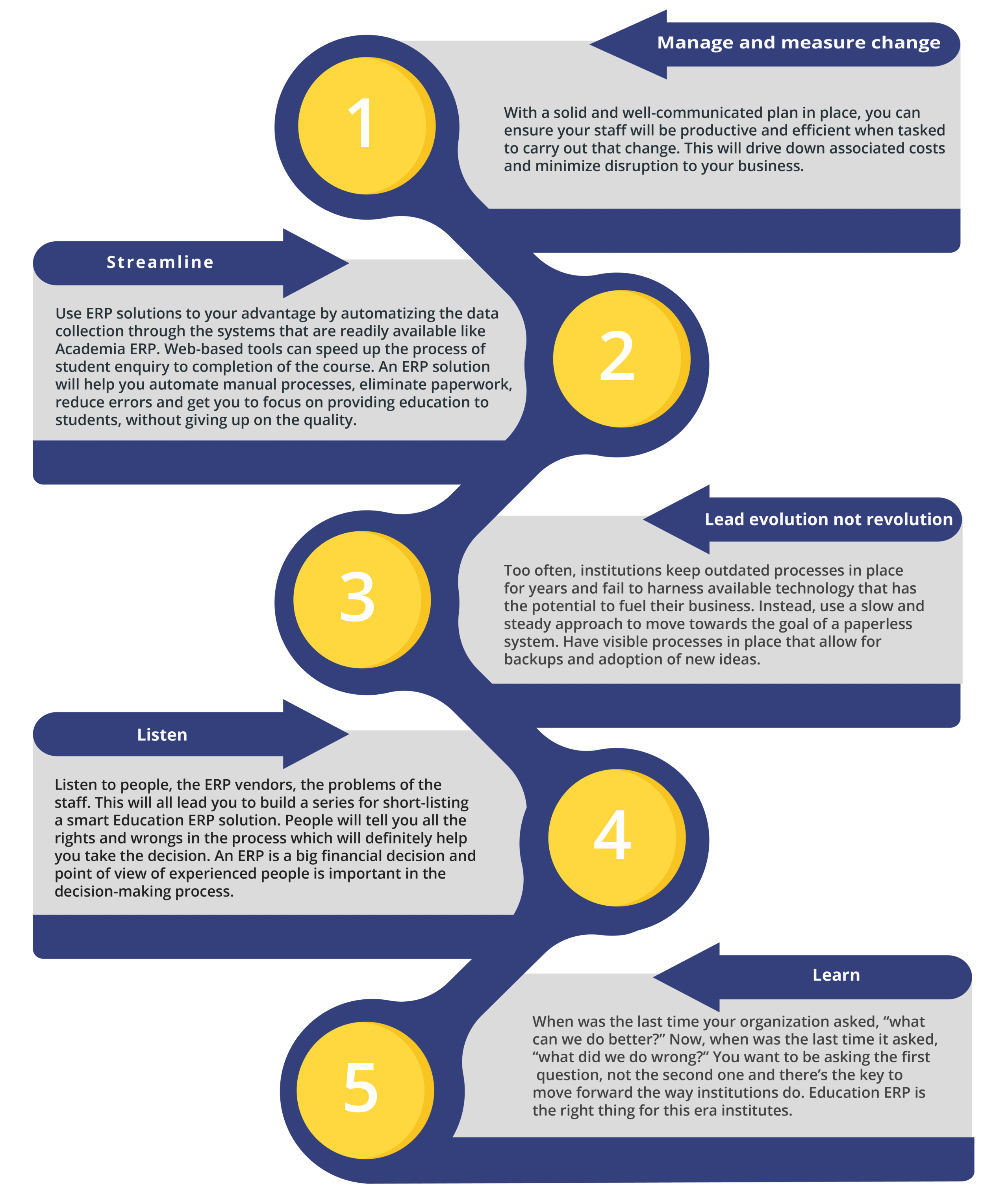
So how do you leverage this formula to become a better and a more successful Institution? It’s simpler than it might seem…

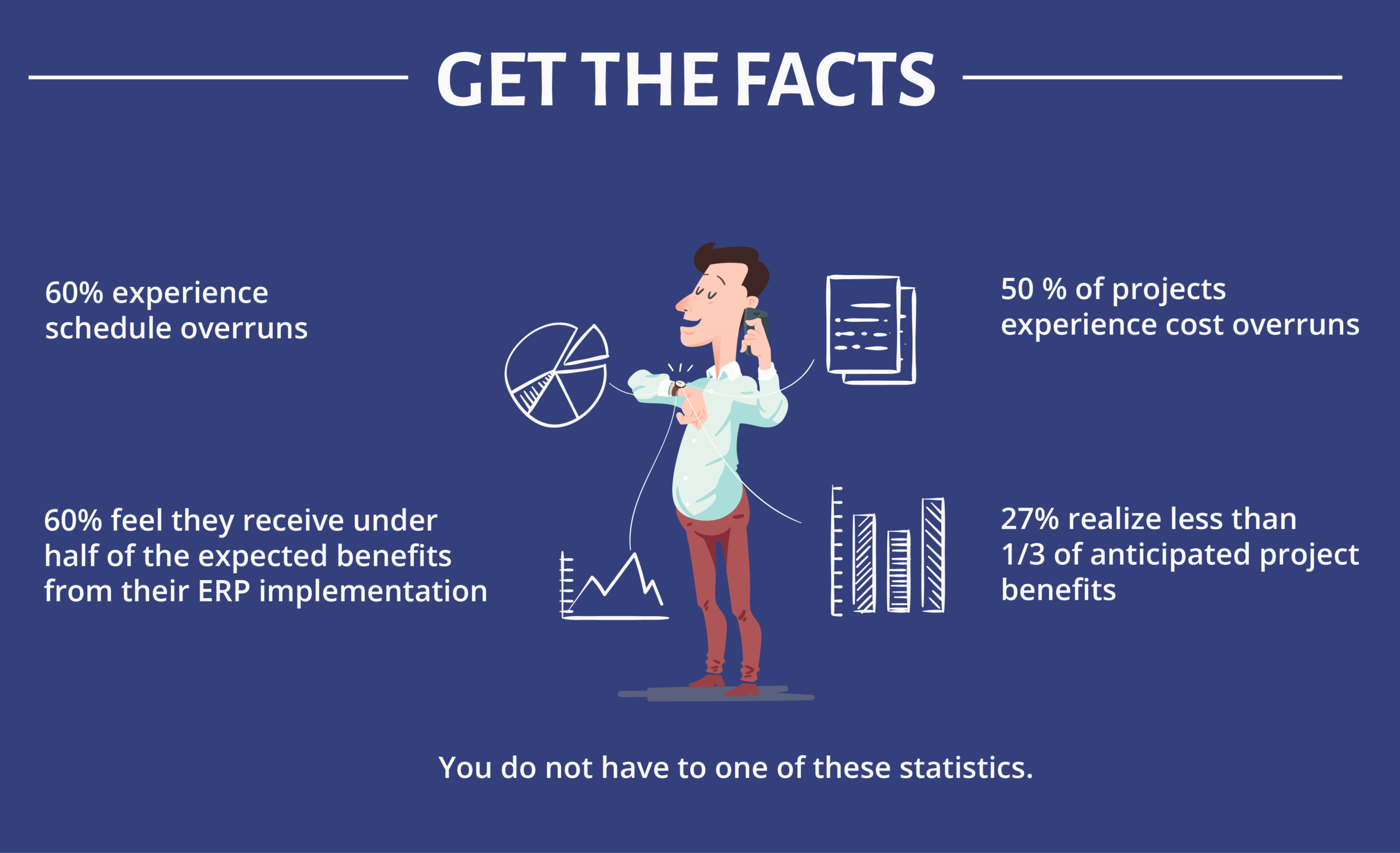
Even Institutes that are satisfied with their software run the risk of running over budget, and many do not receive the expected benefits.

the facts how erp in education benefiting institutions

online college management software-school administration software-Education-ERP- the-right-thing-for-institutes

ERP doesn’t have to be confusing, and a good solution can help the institution to grow and succeed, but only if used the right way.

Know that these steps will lead you to take confident action in adapting to ever-changing conditions, maintaining the health of education systems fuelling growth, and increasing profitability.

You don’t need to hope for the best when you’re using ERP correctly. The best will happen.

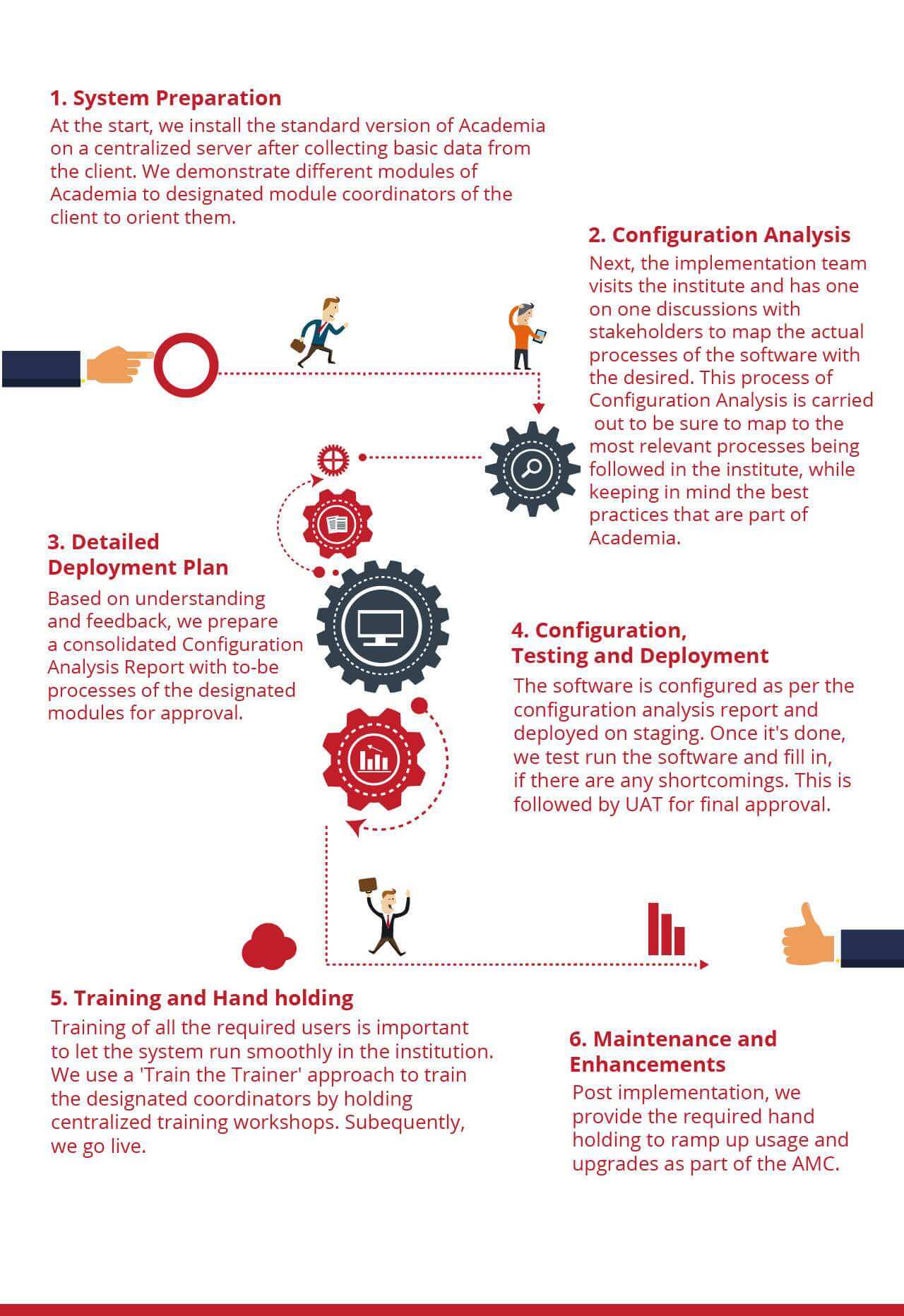
Academia 6-Step Effective ERP Implementation Process

An Education ERP implementation involves installing the software, moving your data over to the institute’s system, configuring your users & the processes, also the training of the users on the software. Choosing the right partner for implementing your ERP system is almost as important as selecting the right software in the first place.

Academia-6-Step-Effective-ERP-Implementation-Process

6 Steps To Perform Student Enrollment Management In Higher Ed

Enrollment management refers to the ability of institutions of higher education to exert more systematic influence over the number and characteristics of new students, as well as influence the persistence of students to continue their enrollment from the time of their matriculation to their graduation. The emergence of enrollment management as a new administrative structure within institutions of higher education originated in North America, but it has also been employed in Europe, Africa, and Asia.

The Concept

Enrollment management can be viewed as a synergistic organizational concept that can be used to link several administrative functions within a college or university in order to optimize institutional enrollment goals. Examples of this approach can be found among the financial strategies of many college campuses, where important linkages have emerged between senior enrollment managers and chief financial administrators. Both private and public colleges use some of their tuition income to fund campus-based scholarships for students. Tuition revenue accounts for millions of dollars, and campus-based financial aid has become a large expenditure at most four-year institutions. Enrollment management efforts have therefore become closely linked to budgeting and campus financial planning. Successful enrollment management strategies and practices must also consider the growing importance of university and college rankings. For many institutions of higher education, enrollment management has come to involve a combination of student enrollment strategy, budgeting strategy, and institutional positioning strategy.

Roadmap

1.  Set goals for enrollments

Setting up realistic goals and working in that very same direction to achieve them is the first necessity of systematic enrollment management for an institute. It is a crucial step since it involves market analysis and calculation of the expected rate of growth.

2.  Resource requirements

To identify the need for the required resources according to the set goals is the next step in the roadmap for enrollment management.

3.  Campaigning and recruiting plan

It is important to create a target focused marketing plan for move in the right direction and reach the set goals. The right kind marketing mix may help you get to the right target audience which would ultimately help us meet enrollment management goals.

4.  A strong follow-up on your marketing and recruitment activities

Tracking your activities is a must in the process of enrollment management to get the results. Following steps can be followed to keep on a regular check on these activities:

1) Identify which metrics to track.
2) Know how to track the metrics you identified.
3) Guide your decisions with the data you collect.
4) Monitor the effect of your efforts and adjusting accordingly.

Having a solid set of marketing and recruitment metrics you can track allows you to benchmark your efforts from year to year and make crucial decisions on allocating resources and strategies.

5.  Systematic communications within the process to develop and implement the right strategy.

With the seemingly chaotic mix of print, e-mail, Web, and social media, there may not seem to be much “flow” with recruitment communications. As with student qualification, though, building a communications flow remains a bountiful recruitment strategy if it is handled strategically.

First, you still must think through the communications at various enrollment stages—inquiry, applicant, admit, deposit. Regardless of where a student enters the flow, progressing them to the next enrollment stage remains the goal.

Second, focus your electronic communications wisely. Having a Web site that engages students is paramount. You want to invite communication in addition to delivering information. Give students opportunities to provide their e-mail addresses or even opt in to text messaging. Do the same with social media but be careful not to go overboard. You are better covering fewer social media outlets well rather than spreading yourself too thin.

Finally, get parents and guardians involved in the flow. According to our E-Expectations research, 60 percent are involved with the college research process. Target them with communications and make them ambassadors for your campus.

6.  Award financial aid so students get what they need and expect to enroll

The ability to afford a college education has emerged as the biggest roadblock to attending college. Perhaps nothing will turn away a prospective student faster than a feeling that they cannot afford your institution. You must address this concern immediately and accurately.

Role of an ERP in Making Educational Institutions Future-Ready

The challenges faced by modern-day institutes are very different from the challenges faced by the education institute a decade ago. The world never shut down as it did 3 years ago and COVID-19 put the education sector in a challenging position to continue its duties of providing knowledge and skills to the world. 

This led to a rise of education technologies and institutes no matter the size and type of adopted the specific technologies built for the education industry. Gradually but eventually, the education sector understood the importance of going tech-borne. They got a chance to explore technology to combat their long-existing issues and challenges and how they can be future-ready. 

Today, they are reinventing themselves with technology and are using software to automate their academic and administrative operations to focus on their core responsibilities. They are using data to take student-centric decisions. They are reducing their dependency on human resources and the list of the wonders goes on and on. 

Role of ERP in making education institutes future-ready

  • Improved accessibility 

Data is the fuel on which every industry is thriving. Simply put, you can see a massive difference in your staff productivity just by improving the accessibility of data. Using insights they can take faster decisions for improved student experience and higher retention. It provides ease in operations and improves interdepartmental functioning while reducing dependency on human resources. 

  • Adopting varied teaching methods

Programs and course management are one of the most difficult tasks. Especially, if you are using a variety of different teaching and learning methods. Using an ERP solution would help you in mapping the objectives and outcomes of the teaching methodology to improve lesson planning, timetable management, resource allocation, examination, student performance tracking, and syllabus tracking. 

Using ERP helps you manage programs and courses better and other entailing operations to ensure a better learning experience for students and ease of teaching for your academic staff. So, if you are thinking about implementing Student-centered Learning, Outcome-based Education, Choice-based Credit System, Personalized Learning, or any other modern education approach, go for education ERP. 

  • Student Lifecycle Management

Systematic academic and administrative management through traditional methods was a time-consuming and laborious process. But with software solutions, you can do it much more efficiently. 

Enterprise Resource Planning Solutions for education institutes help you increase transparency in operations and improve decisioning by providing you with data-backed insights. It also helps you in managing student records electronically and provides you with access to information anytime and anywhere. 

The data is updated in real-time and is centralized to be accessed as per admin-defined access authorization for optimal usage. This reduces the chances of errors, chaos, and confusion leading to improved student lifecycle management. 

  • Unrestricted growth

If you are considering expansion then technology is a must. Most institutes that run their operations traditionally fail to replicate the quality of education and services to parents and students in the academies that are far from their central administration office locations. 

A lot of cases emerge of ignorance and lack of accountability, effecting the reputation of the institute. But modern education ERP offer multi-premise institute management where a central administration team can manage, monitor and administer the operations and processes of all the academies in different locations from a single dashboard. 

This gives you more control over the quality and ensures a greater transparency in operations. This also reports reporting at all levels. 

  • Improved ROI

ROI is probably the biggest metric for any industry to understand the profitability of an institute. With modern education ERP, you can reduce the operational cost of an institute by several times and improve profitability through better management.

Reduced manual intervention, paperless operations, increased enrollment rate, improved resource planning and management and so much more, the list of things that can contribute to a higher ROI is huge. 

How can Academia ERP make your institution future-ready?

Academia ERP is a leading education ERP. It is helping more than 320+ institutions across 22 countries in the world. It includes all the modules that can trigger automation in extreme ways. It includes a robust portal and mobile application that helps all the stakeholders to manage their tasks and operations from anywhere and anytime. With all these, it has a rich analytical system that records and analyzes a huge amount of data with 24/7 assistance from the team for educational institutions. 

More than 400+ institutions are future-ready and are on the path to achieving growth day by day along with technological advancements with us.  Are you ready to be counted in? If yes, reach out to us today, and one of our experts from the team will coordinate with you for further assistance. 

21st century’s education system must be ERP driven to be effective

“Technology has to be either invented or adopted.”

The invention is not for everybody, so then one must choose adoption.

Since more than a decade, technology is making lives easier with each passing day. Technology advances show people a more efficient way to do things, and these processes get results.

Every industry has grown many folds with technological advancements and ERP- Enterprise Resource Planning has been a Hot potato since then. Because it brings effectiveness in the efficiency of day to day working and penetrates in cost-cutting too. Accommodating it i\nto an organization is sure not an easy job at the start but eventually, it results in entrepreneurial efficiency in its operations.

ERPs have been in trend for mostly all the industries but specifically, in the education sector, it’s been more emphatic. ERP in education is in a nascent stage when we talk of the Indian market, but more and more universities, schools, and training institutes are picking up ERP’s, this rise is evident due to the downward arrows in effectiveness, quality, efficiency, and data recording. Therefore, ERP has helped organizations with reduced lead-time, improved quality, reduced asset turns, higher productivity, and improved decision-making. The focus of education management software dominantly falls on centralized control and efficient database management to allow better control over information, data, and reports needed for authoritative control.

The educational institutes should prioritize the development and retaining of quality in delivering the right education which might only be possible when educationists focus on education and not peripheral services. The divergent part of any university, college, school or training institute has always been the management and administration part which can be taken care of by ERPs with innumerable facilities (modules) provided in these types of management software like student information, fee collection, scholarship management, inquiry management through timely reverts, transportation (bus with GPRS facility), accounting and documents generation (like mark sheets, vouchers, bills etc.) etc..

Considering the Future, this is the right time to invest in ERP solutions for harvesting the maximum returns. Once the software is incorporated in the management it delivers a smooth functioning in the organization. The integrated enterprise technology can connect and improve business performance by optimal resource utilization. Optimality plays a key role in strategy formation for cost savings and ERP has been one of the best solutions with optimization as a key deliverable as it emphasizes on procurement of less human resources for data handling and efficiency plus accurate reporting.

Academia ERP is one of the best campus management software present in the world. It’s a product which has scalability written in its core and thus it has this unique functionality to support multi-organization definition. Also, it can be customized and made permissible in accordance to the various functions it adheres.

Academia gives you access to different portals viz, Parents portal, Students portal, Faculty portal which allows and acts as a medium of smooth communication between Student-Faculty, faculty-parent, Parent-management, Faculty – Management, etc. This also allows for various stakeholders of the organization to view and raise requests which in turn can act as internal quality control measurements. It also helps to simply automate the process which infers speed in the regular operations resulting in benefits which involve time-saving, cut on employee costs, strict monitoring, and better control.

Academia enables an institution to deliver the education which is promised and cutting the worries of administration till the edge. A right type of ERP will help manage the overall processes that may involve the management of resources which are limitedly available with the institutes. The simple idea is smooth automation for accurate results.

The growth that any organization seeks is one that brings real benefits to the people, raises the quality & efficiency of organizational processes.

Make the right decision by choosing the perfect fit management software for your institution.