Lorem ipsum dolor sit amet, consectetur adipiscing elit. (Sed )do eiusmod tempor incididunt ut labore et dolore magna aliqua.

X

Type your keyword below

6 Steps To Perform Student Enrollment Management In Higher Ed

Enrollment management refers to the ability of institutions of higher education to exert more systematic influence over the number and characteristics of new students, as well as influence the persistence of students to continue their enrollment from the time of their matriculation to their graduation. The emergence of enrollment management as a new administrative structure within institutions of higher education originated in North America, but it has also been employed in Europe, Africa, and Asia.

The Concept

Enrollment management can be viewed as a synergistic organizational concept that can be used to link several administrative functions within a college or university in order to optimize institutional enrollment goals. Examples of this approach can be found among the financial strategies of many college campuses, where important linkages have emerged between senior enrollment managers and chief financial administrators. Both private and public colleges use some of their tuition income to fund campus-based scholarships for students. Tuition revenue accounts for millions of dollars, and campus-based financial aid has become a large expenditure at most four-year institutions. Enrollment management efforts have therefore become closely linked to budgeting and campus financial planning. Successful enrollment management strategies and practices must also consider the growing importance of university and college rankings. For many institutions of higher education, enrollment management has come to involve a combination of student enrollment strategy, budgeting strategy, and institutional positioning strategy.

Roadmap

1.  Set goals for enrollments

Setting up realistic goals and working in that very same direction to achieve them is the first necessity of systematic enrollment management for an institute. It is a crucial step since it involves market analysis and calculation of the expected rate of growth.

2.  Resource requirements

To identify the need for the required resources according to the set goals is the next step in the roadmap for enrollment management.

3.  Campaigning and recruiting plan

It is important to create a target focused marketing plan for move in the right direction and reach the set goals. The right kind marketing mix may help you get to the right target audience which would ultimately help us meet enrollment management goals.

4.  A strong follow-up on your marketing and recruitment activities

Tracking your activities is a must in the process of enrollment management to get the results. Following steps can be followed to keep on a regular check on these activities:

1) Identify which metrics to track.
2) Know how to track the metrics you identified.
3) Guide your decisions with the data you collect.
4) Monitor the effect of your efforts and adjusting accordingly.

Having a solid set of marketing and recruitment metrics you can track allows you to benchmark your efforts from year to year and make crucial decisions on allocating resources and strategies.

5.  Systematic communications within the process to develop and implement the right strategy.

With the seemingly chaotic mix of print, e-mail, Web, and social media, there may not seem to be much “flow” with recruitment communications. As with student qualification, though, building a communications flow remains a bountiful recruitment strategy if it is handled strategically.

First, you still must think through the communications at various enrollment stages—inquiry, applicant, admit, deposit. Regardless of where a student enters the flow, progressing them to the next enrollment stage remains the goal.

Second, focus your electronic communications wisely. Having a Web site that engages students is paramount. You want to invite communication in addition to delivering information. Give students opportunities to provide their e-mail addresses or even opt in to text messaging. Do the same with social media but be careful not to go overboard. You are better covering fewer social media outlets well rather than spreading yourself too thin.

Finally, get parents and guardians involved in the flow. According to our E-Expectations research, 60 percent are involved with the college research process. Target them with communications and make them ambassadors for your campus.

6.  Award financial aid so students get what they need and expect to enroll

The ability to afford a college education has emerged as the biggest roadblock to attending college. Perhaps nothing will turn away a prospective student faster than a feeling that they cannot afford your institution. You must address this concern immediately and accurately.

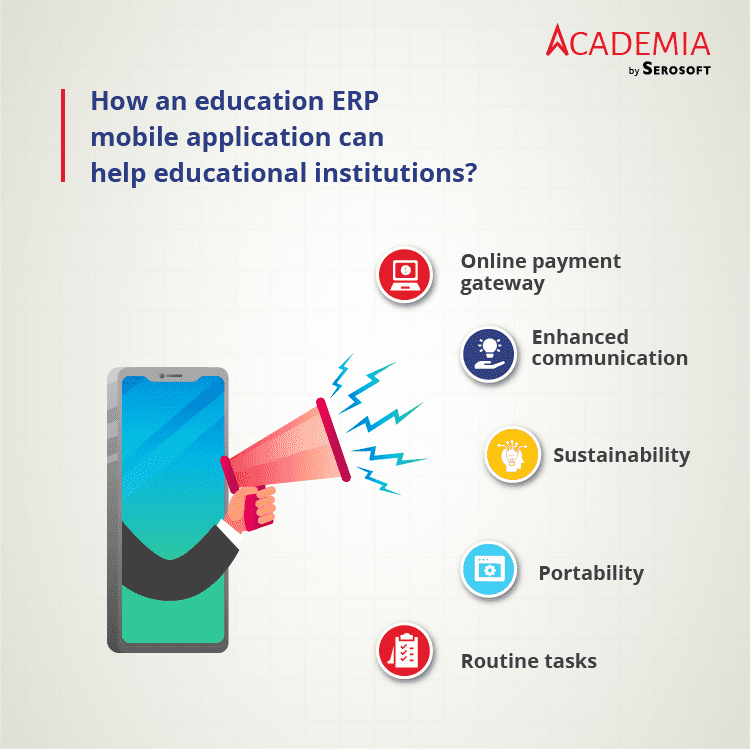
Benefits of Mobile ERP Applications in the Education World

From the last few decades, technological advancement in education has been immense. Education previously was associated with traditional classrooms but with increased use of technology, enhancement in education is being the new trend, one of the most common technology uses in education are mobile applications. An education ERP mobile application can help educational institutions manage and streamline their operations in a more systematic and enhanced manner. 

So what do you know about having a mobile ERP application? Let’s discuss its usage and benefits for the education system. 

Benefits of using a mobile ERP application for the education system

Mobile ERP Application

  • Enhanced Interaction 

Mobile apps associated with an ERP have proved to be the best in increasing the interaction between faculty and students. A robust ERP system provides a mobile app that helps in integrated and enhanced interaction among faculty and students. With an ERP mobile app students get the opportunity to resolve any query anytime with the respective faculty and likewise, the faculty can discuss anything anytime with any student having facilities like messaging and notifications options. Isn’t it awesome? 

  • Increased Communication

Communication is the key factor in any educational institution, it needs to be perfect in both external and internal management. An ERP mobile application provides seamless communication between administrative staff, faculty, parents, and students. It provides all the features updated in a single mobile application that can be used by any educational authority associated with the institution as per their requirements. It gives access to parents to ask and generate any query related to their kids and likewise, teachers and other administrators can solve and ask any questions any time with parents and students using the mobile app. This is so quick and simple! 

  • Efficient administrative management 

In any educational institution, there are multiple administrative tasks from admission, enrollment, fee, hostel, and various others. All the operations must remain systematic and efficient in any manner. With the traditional or manual way of working, all these tasks remain slow, ineffective, and sometimes include various errors, meanwhile, it is important to note that not always manual interventions create ineffective management but we can say it always will remain slow and tedious as expected to digital completion of all these tasks. 

A mobile app integrated with an ERP provides systematic and online management 

of all the operations from admission to alumni of a student, it makes easy management at each end i.e., student, parent, faculty, and the admin staff. Sounds interesting?

  • Systematic academic operation

Academics are all where students get the education and learning in any educational institution. Academic operations like teaching, learning, examination, result declaration, and various other tasks need to be managed effectively and efficiently as they directly affect the education and learning of the students, so for these, educational institutions must opt for software that leads toward effective, efficient, and systematic workings in the institution. Think how easy all these will happen if faculty and students can attain these tasks from their mobile phones, isn’t it easy and flexible? 

A mobile application integrated with an ERP system provides access to all the academic operations on the mobile application, students can easily access the mobile app attaining all the information simply with a few clicks. Starting from the admission of the student, enrollment, classes, examination, results, and even alumni of the student. Everything can be managed using the education ERP mobile application. Ah, amazing!

  • 24/7 availability 

Unlike traditional classrooms, mobile applications provide 24/7 availability, students, faculty, and not even the administrators need to wait for the schedule, a mobile app provides anything, anywhere, and anytime. An ERP mobile application for educational institutions always promotes child-friendly control so that any technical or non-technical person like parents or other staff can easily access it anytime. 

  • Systematic learning process 

Those were the days when students only had access to learning stuff in the classroom, now with the increased technology various online tools can make it systematic with efficient learning like ERP software. An ERP mobile application software provides a systematic learning process making everything easier and accessible for the students and they can attain any study material, can resolve any query anytime, can connect with the faculty using the mobile application. Easy, what do you say?

  • Instant updates 

It is one of the best features of the ERP mobile application, it provides necessary notifications to faculty, students, and parents to complete the operation at its due date. An education ERP mobile application provides notifications to students on the due date of fee submission, admission form filling, examination date, and a lot more, and likewise for faculty, administrators, staff, and even parents. Tremendous faculty, agree?

Wrapping up!

So, what do you think, and education ERP mobile application will help the most for which operation? Let’s have a discussion to make it more relevant. We are one of the leading education ERP software and focus to provide complete digital transformation and automation in educational institutions. Wanna know more? Check Academia now or book your demo!


Student Information System: Optimizing Student Success Through Technology

In today’s fast-evolving educational environment, higher education administrators are not only faced with the need to nurture young talents and focus on the professional and learning development of students, but also can track, organize, and report on critical data. From meeting numerous reporting requirements for the various school departments to managing the day-to-day operations of the school, there is a lot that needs to be done to ensure an institution runs smoothly. These factors underline the importance of student information systems and how it minimize administrative burden and increase student success.

What makes a student information system effective:

A student information system that has an improved student enrollment helps the admissions department track prospective students during the application and enrollment process. The enrollment process is time-consuming, as there are many requirements to be fulfilled. With an influx of data, administrators need to ensure students enjoy a seamless transition from the application process to the final admission to the college or university. An improved management of student enrollment is one of the outstanding advantages of a student information system, and ensures student success.

Why you need a robust student information system for success:

A student information system with a variety of self-service capabilities will also ensure student success. The student information system provides an enhanced user experience to all its users including faculty, students, and staff with all the information and access they need to succeed.

For students, it offers information on their academic progress, registration, course catalogs, resources, class schedules, grades, and transcripts, all in one place. For administrators and staff, it solves various departmental needs like configuring, maintaining, and adding action items to specific groups and more.

A student information system would also provide better communication between departments and students, analytics and data through a seamless dashboard (with the power of AI), better educational support, and so much more. Sia is one student information system that is transforming higher education. Sia is a unified artificial intelligence engine for all your institution’s needs. Get in touch with us and upgrade your Organization with the power of Unified AI now.