Lorem ipsum dolor sit amet, consectetur adipiscing elit. (Sed )do eiusmod tempor incididunt ut labore et dolore magna aliqua.

X

Type your keyword below

5 Common Higher Education ERP Implementation Mistakes To Avoid

Technology is playing a key role in today’s era. Every segment and industry is shifting to opt for technologies that can upgrade and help them in being the competition. Looking in the education sector, it is now important for educational institutions to opt for technologies like ERP/SIS that can eventually help them in associating and operating the day-to-day operations of the institute. A better and robust ERP system can eventually help educational institutions to manage all the administrative and academic operations of the institute.

But educational institutions must select a good ERP platform that can help institutions in attaining growth along with fulfilling all the requirements. Even after selecting a very good ERP, institutions sometimes make mistakes that should be avoided while implementing an ERP system in the institute.

Let’s take a look at a recent interview of an ERP specialist taken by an educational media interviewer. In this, he asked about the common mistakes that can be avoided by institutions while having an ERP implementation.

Question 1

How can the institution prepare itself for digital transformation?

Answer by ERP Specialist: 

Digital transformation is considered the new need for educational institutions, it helps in streamlining and managing all the academic and administrative operations. But in my opinion, there is a proper process that institutions need to understand before thinking to opt for digital transformation. Different educational institutions today are at different stages of digital transformation, hence, they all need customized paths to achieve 100% digital transformation. These stages or situations can be majorly classified into 3 major categories:

  • Situation 1:

Manual Interventions in the institution

I think there are more than thousands of institutions that are still working using the manual process in their institutions. I do not regret the point that manual intervention can also help institutions to grow but the fact is its slow growth and which in today’s time is considered as no or less growth. Let’s take the example of the admission process of an institution using the manual process. It starts from a long queue for the admission form and ends with a lot of documentation from both ends for enrollment, right? It becomes a hectic, long, and confusing process for students, faculty, and staff. So it is the right time for institutions that are still operating with manual processes to understand and choose to move towards automation of each process in the institution.

  • Situation 2 

Semi-Automation

In my opinion, there are various higher education and K12 institutions that have opted for semi-automation. Semi-automation is considered as the situation in which institutions opt for individual software to automate some of the processes of the institution like the Learning Management System (LMS) to enhance the learning experience of students, Tally to audit databases, and various others. I think this eases out the work but initially, it increases the chances of more confusion among the administrator and faculty as multiple software increases the need for multiple hands to operate and track each data.

Institutions must opt for an ERP along with some of this software, as it helps in storing and tracking all the data from one single software that can be used by any of the administrators, faculty, or staff members. A good ERP system also avails interoperability of other software along with the ERP. It manages all the operations from admission to the alumni and the student giving easier and more efficient access to everyone available in the institute.

  • Situation 3 

Having an inefficient ERP System
Once I visited a higher education institution, they already had an ERP system that they were using to operate several tasks like admission, fee, examination, and many others, but to my surprise, I found that they have witnessed the same growth even after using the ERP system for their academic and administrative operations. Then I checked with each team who was operating the system what was the issue, it amazed me more when I found the real issue was the ERP itself. It was hard to understand for a normal faculty or student, it was not easy to operate, and it does not even have a mobile app to provide easier access to students.

So as per my experience, it is most important for educational institutions to choose an ERP system that provides them with complete functionalities, no or very less code language, proper training, systematic implementation, and all other important functionalities that a good, robust, and flexible ERP should have.

So this way, institutions have to analyze their position before seeking digital transformation in their institution.


Question 2

Interviewer: 

What is the training process that institutions should opt for while implementing an ERP system?  

Answer by ERP Specialist: 

Hmm, the answer to this is also quite interesting, because various institutions opt for an ERP system but fail to seek a proper training process for administrators and faculty which leads to the unsuccessful implementation of the ERP system. Institutions must choose a perfect ERP system leading to proper training from the implementation team of the ERP vendor company. 

An institution must check every detail before seeking for implementation of the ERP software, the training and implementation team will include these steps:

  • Firstly, the ERP implementation team should visit each campus of the institution to analyze the current working process and the needs of the staff and administrators. 
  • After understanding the needs and working process of the institute, the institute must focus on initiating the training process of the administrators and staff who are going to operate the software in the future. 
  • As the last step, the training and implementation team must check that everyone in the institute is comfortable with using the software and is initiating all the processes like the admission process and all the other processes effectively using the software. 

Question 3

Interviewer:

Is change management important or should it be avoided? 

Answer by ERP Specialist:

I think this is high time for educational institutions to opt for change, and a good ERP system can help them in initiating this process. Although institutions must opt for the proper change management process before initiating any kind of new implementation in the organization. 

Now, if you are thinking about what change management is and why it is important, let me help you understand it properly. Change management is an art, that requires a careful balance between faculty, processes, and technology in the context of an educational institution. It needs continuous judgment, evolution, and strategic decisions at each end, and the first one to implement is choosing a good and best ERP software. In my opinion, Academia ERP is one of the best, most flexible, and scalable ERP software that provides the best technology adoption to institutions who even are far away from advanced technologies in their institute.

Question 4

Interviewer:

Is inadequate budget can also be a problem while implementing an ERP system? 

Answer by ERP Specialist:

There is nothing like an inadequate budget, if a higher education institution focuses on bringing advancement and growth they can manage any circumstance. I mean, educational institutions need to understand that an ERP system is a step that can help them in achieving new goals along with more opportunities, it leads to systematic management of all the academic and administrative tasks in the institute. 

Institutions who are having a tight budget must choose a very good and reasonable ERP system that can provide them with bringing automation and digital transformation to their institution. Here it is also important that institutions must find a good ERP system, as in search of a reasonable software compromising the success that a good ERP software can provide can also become a mistake for an institution’s growth.

Question 5

Interviewer: 

What is the common mistake that most institutions make while having an ERP implementation?

Answer by ERP Specialist: 

Educational institutions need to understand that successful ERP implementation can help the overall educational institution with streamlining workflow, optimizing costs, and the systematic arrangement of all the academic and administrative tasks. But institutions must avoid these common mistakes:

  • Not able to explain proper requirements to ERP vendor
  • Not taking into account the end-users that are individual department heads
  • Implementing the ERP software just after one initial discussion
  • Not having regular maintenance

Last Conversation:

Interviewer: I hope this knowledge given to you will help educational institutions when they focus on striving for digital transformation in their institution. Any recommendations that you wanna give to our readers while selecting an ERP software vendor. 

Answer by ERP Specialist:

Yes, of course, I would suggest institutions opt for a good, scalable, robust, and flexible ERP system in their institute, they must need to be very careful while selecting the ERP software. I would recommend checking with Academia, it is one of the best and award-winning software that provides one of the best institutional management in all prospects avoiding all the major mistakes we have talked about in this session. 

Difference between Digitization, Digitalization, and Digital Transformation

The COVID-19 pandemic has embraced digital technologies to keep the learning continued and improving. Educational institutions have opted for various technologies that helped them manage resources, improve safety, and increase effectiveness.  

With the emerging technologies, institutions often get confused between digitization, digitalization, and digital transformation. So in this blog, let’s discuss these three terms and concepts closely along with their values in the context of education. 

What is digitization?

Digitization in education is the process of converting information from a physical source to a digital one. It directly helps in converting non-digital documents into digital representations that are automatable according to the workflows. Digitization also enables processes to create business value accessed anywhere, anytime. It also lays the foundation for businesses’ use cases that leverage the data.

Examples of digitization include scanning a paper document and saving it on a computer’s hard drive as a digital document, choosing Excel spreadsheets from paper formats, and more. 

What is digitalization?

In a broader sense, digitization and digitalization are closely associated. They are often considered the same terms, but looking deeper into it, both are different, having different meanings and values. Digitalization means making the best of digitized resources and work. It more often helps in connecting through digital technologies to improve overall efficiency along with creating a digital culture at its core.

One of the common examples of digitalization includes converting Excel spreadsheets, documents, and more to the cloud. Through this, institutions can work in a structured environment where the documents can be shared and accessed among stakeholders according to their needs.

What is digital transformation?

Digital transformation is the complete transformation of activities, operations, processes, products, and functionalities leveraging opportunities of digital technologies. It includes both the terms digitization & digitalization. 

Institutions in the modern age can choose digital transformation aiming for efficiency, productivity, and new monetization opportunities. It can help institutions to bring new-age learning to all prospects. 

One of the common examples and benefits of digital transformation is moving the data of admission or any other operation from a Google tool into software like ERP that can analyze the data. 

The main benefit of digital transformation for educational institutions is to provide ease, productivity, and growth through all the academic & administrative operations for all the stakeholders associated with the institution.

The Difference between digitization, digitalization, and digital transformation

Digitization, digitalization, and digital transformation are co-related terms and help educational institutions achieve automation. Meanwhile, it is crucial to understand that digital transformation is the broadest term that involves both digitization and digitalization. 

According to Gartner, digitalization and digital transformation have a growing impact with enhanced expectations from students, staff, and faculty. 

Digital transformation helps in automating complete functioning & transforming manual functioning into three processes: first digitized, second, digitalized, and last yet the most important digital transformation. 

Various technologies like ERP/SIS, help educational institutions automate all their operations, and activities, and opt for digital transformation leading to unstoppable success and achievements. 

Conclusion 

So at which stage your institution stands – digitization, digitalization, or digital transformation? Nevertheless, institutions must understand that if your institution has opted for digitization, it is nothing but a step ahead of manual intervention. With the enhancing EdTech opportunities, institutions should need to choose digital transformation with advanced software like ERP/SIS. 

Academia ERP/SIS provides absolute digital transformation to all the academic & administrative operations of your institution. The key aspects of digital transformation for your institution include:

  • The digital transformation of complete manual processes even from paper, documents, or Google tools. 
  • Interoperability with other software and systems for seamless workflow and management. 
  • Multi-center capability for managing multiple locations & campuses with ease. 
  • Mobile application for easy access from anywhere and anytime for any stakeholder. 
  • Boost productivity and ROI. 

So, what are you waiting for? Seek digital transformation now! Just fill out the form and one of our experts will get to you as soon as possible. 

How Education Management Software Can Help Educators to Step into the Future

With the incursion of technology in our daily lives, we have started to depend on technologies for our work. It helps us in all the fields by manual efforts, reducing costs, paperwork, etc., and allows us to focus on the core problems. Education Management Software is the greatest management tool for all the sectors that perform various sets of activities and want efficient & cost-effective management.

The days are gone when educational institutions were limited to teachers and students. Today, the education sector has grown into a giant industry that requires extensive interdepartmental collaboration even for minor tasks. This, in turn, has resulted in a need for better management and administration of resources. Nowadays the education sector around the world is transforming digitally. And here comes the Education Management Software in the picture.

What is Education Management Software?

It is a software solution that helps to manage the complete student life cycle from admission to course completion. It gives a centralized platform to educators, staff members to control, monitor, and manage the day to day tasks in a seamless manner. The software comes up with defined modules for each administrative department. The modules are customizable and configurable according to the needs of the institution. It offers interoperability to manage operations such as Learning Management System, Course Management, Data Management, etc. It empowers institutions by enabling digital transformation and allows them to focus on student and institutional development.

Here are the benefits of using Education Management Software:

  • Improved Enrollment Rate

Education leaders can leverage the automation with educational ERP to boost student enrollment rate in their institute. Whether it is higher education or K12, both have a hectic schedule of the difficulties in the decision-making policies, hence, sometimes they get troubles checking in with the enrollment rate of the students. To remove these situations, it is required to implement an advanced software that can eliminate the burden from various mundane activities and brings proper admission management. Educational management software automates the paperwork, digitizes the academic operations, simplifies the complex administrative operation, and enables the institution to focus on increasing the enrollment of the students.

  • Cost-effective

Cost-effectiveness is one of the crucial advantages of Education Management Software implementation. The Educational Software down the paperwork, manual tasks involved in the fundamental methods of campus administration such as the student enrollment process, collection of the fee, examination management, payroll, admission, and other activities to reduce the number of man-hours, leading to the cost-saving. The expenditure saved can be used for other developmental educational purposes.

  • Efficiency & Productivity

The educational management system helps administrators of educational institutes enhance their productivity and eliminate the time & effort required to manage the educational institution. It allows them to accurately organize institution data efficiently. It saves teachers time from mundane activities such as; attendance marking, record management, paperwork, etc. Due to minimizing paperwork and more time towards goals, the Education ERP software enhances the productivity of teachers as well as staff. 

  • Better Decision Management

Education management software fastens the complete operations of institutional management to the next level. All you need to spend time and wait for the implementation of the Education ERP software and you are all set for better, faster, and smarter management of your institution like never before. The enrollment process of the upcoming batch of students or creating customized fee reports or generating marksheet reports will be done in minutes. This system provides faster access to information about the students, admissions, reporting, timetables, employees, examinations, financials, fees, etc. It helps the administrators and educators to analyze various aspects of the institution better that lead to growth planning. Advanced data management also enhances well-informed decision-making through well-strategic data analysis.

  • Enhanced Experience 

A smart Student Management Software puts an end to man-hours of cumbersome resource databases. The software can easily keep track of real-time resource usage and inventory, enabling you to optimize operations, control, and monitor all activities running in your institution. The workload due to the manual resource is eliminated as the teachers need to be technology-driven. This will lead them to work upon the ERP system and send out the information to the students and parents over the system within a few clicks. It reduces the workload and saves ample time, which can be utilized for some other work.

Conclusion

Education management software has offered many more benefits such as online classes, hostel management, library management, employee management, HR management, etc. With the right education ERP software, your institution can have all these benefits. Moreover, it enables you to aim towards the main objective of your organization. 

Academia Education Management Software brings digital transformation in educational institutions of all sizes whether universities, colleges and schools, or training institutes. It is benefitting more than 600K learners & educators around the world. You can be one of the benefactors too. Learn how Academia works for educators with a free demo. Book NOW!

6 Reasons Why School Should Use to Cloud Technology for Administrative Management

[vc_row][vc_column][vc_column_text]

Cloud technology has become the need for most of the organization. Whether it is a small, medium or large, they all need a system that can give them a single platform to process all the operations within the institution. Not only it benefits the employees but it also plays a significant advantage for all customers.

Education institutions are also growing at a high pace. This sector is expected to reach US$ 1.96 billion by 2021 with around 9.5 million users. This includes K12 and higher education. With this increment, institutions need to upgrade their system to manage the processes properly.

Higher education institutions are rapidly adopting the technology because of this millennial and generation Z and their expectation with the organization. Cloud is one of the technologies that is benefitting educators & learners around the world. Unlike higher education, schools are less inclined to shift their day to day processes into the cloud, and due to that, they are missing out on the key benefits of it.

Here are the reasons why schools should start shifting to cloud technology.

  • It brings collaboration6 Reasons Why Schools Should Use Cloud Technology

Schools have multiple departments that are handled by multiple people. Sometimes it becomes difficult to make the information flow without hurdles. With so many people involved, it increases the chance of error or miscommunication. However, with the help of Cloud-based software, this can be avoided. It provides collaboration as it centralizes the data in a single platform. Any authorized user can access the information whenever, wherever they want. For a school, the different users are parents, teachers, and students. With cloud-based ERP, a school can increase communication between parents and teachers. Parents across the globe can access their child’s academic records and progress from their mobile phones or laptops. Teachers will access the system regularly from school and occasionally from their homes. This became possible because of cloud technologies.

  • It gives a disaster recovery solution

If you are using the traditional method of administrative management in school, it is possible to lose data. Even if you are saving data in the computer or hard drive, data can be lost due to malware, hardware damage; which you can avoid if all the data is saved on the cloud. This is one of the key benefits of cloud-based school management software. The providers have the support system that can help institutes to recover data if they ever lose it. Therefore, you never have to worry about any documentation loss, ever.

  • It reduced capital expenditure

When schools think about shifting to cloud technology they usually get worried about the investment and high procurement costs. In contrary to that, the cloud is cheaper than they spend in IT & Hardware. Along with the licensing amount, to enable this technology you basically need high-speed internet and computer/ laptop. You can start and stop the services anytime you want. This technology also reduces the operational expenditure. As it reduces documentation storage costs, printing costs and maintenance costs.

  • It is flexible to work with

Solutions like cloud-based education ERP give a flexible approach for teachers and other stakeholders to work. Teachers can work in the school as well as from their home as and when required. Academia Student Information System also offers portals/ apps for teachers, administrators, parents and students by which they can operate via their mobile also. Parents can check their children’s updates from their portals. No need to stand in lines for long hours, no need to visit multiple departments to collect documents and no need to go to school to submit fees. They can go portal/ app and can do all that stuff with ease.

Know more about Academia Student App

  • It gives data security

In today’s era, everything is digital, so is the crime. If you are turning into a digital platform you can’t turn away your face from data theft. Although schools do not have extremely sensitive data but the loss of information of associated members can make a huge problem. The provider takes care of the security of the system. The information is highly encrypted and only the authorized users can access the information with credentials that he/she only knows.

  • It is scalable

All the organizations look for growth and it would be unfair if technology implementation hinders that growth. Thanks to the scalability of cloud computing it aids the growth of your school. It is the ability to upscale or downscale the software according to the demand for the solution. For instance one year you cross the target of admission rate, from 1000 to 2000. But you started with 1000 student admission. The software such as Academia SMS can be customized to manage the database of 2000 admissions without any manual intervention.

Know how the scalability of education ERP is good for the growth of your school.

Conclusion

These are just some of the benefits of implementing cloud-based ERP, there are many more. Digital transformation in school has become the primary need nowadays. If education leaders want to grow their institute and pace up the advancement in the school management system, they should start thinking about shifting to cloud tech.

[/vc_column_text][/vc_column][/vc_row][vc_row][vc_column][vc_empty_space][/vc_column][/vc_row]

5 Reasons Why Your School Needs An ERP Software

ERP or Enterprise Resource Planning is usually defined as software that aids in managing processes in an organization. Used extensively by business houses, schools, and colleges across the world have also been actively implementing it for their everyday management over the last few years. 

School ERP essentially assists in planning and managing the processes and functions of a school.  This includes a range of things from admissions and onboarding to assessments and student tracking. 

Considering the efficiency and resource management that ERP brings to an educational institute, the software is a significant revolution in management. Imagine eliminating the tedious tasks of managing student records and data manually, writing frequent mails for information sharing, and investing considerable time and resources in consolidating numbers. 

ERP makes all of this possible through automation!

Here are some of the key benefits of School ERP


  • Enhanced and Easy communication

School management software helps teachers connect with their students even remotely and beyond the class and school timings. It is particularly convenient for educators to assign tasks to students through the software. 

What’s more, even parents can access them and stay aware of their child’s studies and progress. This also helps save considerable time even while ensuring that the communication is smooth and direct. Keeping the parents constantly in the loop and allowing them access to their child’s day-to-day tasks is also a great step toward building their trust in the institute.

  • Better Administration

A school management process largely involves continuous administrative work that is mostly done manually. For instance maintenance of daily attendance, fee collections, event details, student assessments, and so on. 

A school ERP software manages all of this and more, resulting in an efficient administration. Precise information can be now collated on a single platform, which helps authorities access it much easier, thus aiding in faster and better administration.

  • Efficiency owing to Customization

Every institution functions differently and demands an exclusive set of working processes. A crucial aspect of school ERP is that it can be customized to suit the needs of every school out there. This allows an institute to switch to digital transformation even while assuring that the processes are efficient and convenient to the school’s daily functioning. For example, fees management which is one of the important modules within an ERP can be customized to define categories of students and their subsequent fee structure within a school.


  • Time and Resource Management

Going digital is a definite way to bring in productivity at various levels in the school – time and resource management being the primary ones. While a chunk of work is managed through ERP, the employees can now plan their schedule better and focus on additional areas of activity. 

In a school where imparting education is the primary focus, being able to save time on all the other peripheral activities and focus on the curriculum, can become a huge achievement for the school’s academic performance.

  • 360-degree automation

Digital innovation is shaping our future and education is an inevitable part of it. An ERP in education, while bringing in 360-degree automation, gives you an edge over the competition owing to its efficiency and innovativeness. And all of this while ensuring that your data is completely secure and protected. It streamlines practically the entire student cycle right from pre-admission enquiry to their graduation by monitoring different activities and linking them together for a piece of consolidated information.

Want to know more? Check out the popular school ERP software, Academia SMS with a free demo from an expert. Book now.

Top 6 Functions of Student Information System that Every Educator Should Know

A well-implemented Student Information System transforms institutional operations and empowers educators to focus on what truly matters—teaching and learning. From managing student data to enhancing communication and improving academic performance, the benefits of an SIS are undeniable.

investing in a robust SIS is no longer optional—it’s essential for institutions aiming to embrace digital transformation. Educators who understand and leverage these six key functions can drive better results for both students and the institution.

1. Student Data Management

The core function of any SIS is efficient student data management. From personal details and admission records to academic progress and health information, the system securely stores all data in one place. Educators can easily access student profiles, track performance, and make informed decisions.  Teachers can tailor their teaching strategies based on individual student needs, ensuring a more personalized learning experience.

Key Features:

  • Centralized student profiles with demographic and academic details.
  • Secure storage and easy retrieval of historical records.
  • Real-time updates for any changes in student information.

2. Attendance Tracking

Every contemporary SIS will have an attendance module. The system allows educators to intervene early if a student is frequently absent. Teachers can mark attendance within seconds, while administrators get real-time reports to identify patterns and address absenteeism. An SIS automates this process, making it efficient and accurate. 

Key Features:

  • Daily and subject-wise attendance marking.
  • Instant alerts for absenteeism.
  • Detailed attendance reports for each student.
  1. Marksheet & Assessment Management

Grading and assessment is a complex process, especially when dealing with multiple subjects and exams. An SIS simplifies this by providing integrated marksheets where teachers can enter scores, calculate final grades, and share results with students and parents. Educators can easily identify students who need extra support while parents stay informed about their child’s academic progress.

Key Features:

  • Customizable grading scales and weightage.
  • Automated report card generation.
  • Performance tracking over time.
  1. Timetable & Scheduling

A timetable can last for six months or more. Creating timetables for classes, exams, and extracurricular activities can be challenging. An SIS automates this process to ensure efficient resource allocation and conflict-free scheduling.

Key Features:

  • Automated class and exam timetables.
  • Schedule adjustments with instant notifications.
  • Resource management for classrooms and teachers.

5. Communication & Notifications

Effective communication between institutes, teachers, parents, and students is essential for student success. An SIS bridges this gap by providing multiple communication channels.  Transparent communication ensures everyone stays updated, reducing misunderstandings and enhancing collaboration.

Key Features:

  • Real-time notifications for attendance, grades, and events.
  • Two-way communication between teachers and parents.
  • Event and exam reminders.

6. Reports & Analytics

Data-driven decision-making can transform education. An SIS provides powerful reports and analytics to help educators identify strengths, weaknesses, and opportunities for improvement. Educators can make proactive decisions to ensure better learning outcomes and efficient college/university management.

Key Features:

  • Customizable reports for academics, attendance, and behavior.
  • Visual dashboards for quick insights.
  • Predictive analytics for academic performance.

Conclusion

Efficient student data management is not just about organization—it’s about empowerment. It equips educators with the tools to provide personalized learning, improves institutional efficiency, enhances communication, and drives long-term success. In an era where data drives progress, institutions prioritizing effective student information management will deliver quality education and foster institutional growth.

5 Reasons Why ERP In Education Is the Need of the Hour

Education technology is paving the way for the digital development of several institutes. Students are the most important part of this chain. 

Catching the pace of students and their tech-savvy parents is now a crucial aspect of the education industry. Quality education, modern infrastructure, and a digitized management system are some of the crucial aspects they look for in education institutions.

Following this trend, the education management system or education ERP is now becoming the need of the hour. It helps streamline and integrate the complete administration processes of institutes.

What is ERP in Education?

ERP in education, usually known as a Student Information System (SIS) is an enterprise software solution to manage the complete student life cycle. It is also integrated with multiple software programs to manage departments of educational institutions.

With the help of Education ERP, it is possible to manage complete admission processes, enable online payments, monitor student records, handle human resource management, and much more.

Check this out to know more in detail about education ERP.

Here are 5 reasons why Education ERP is the need of the hour for the education sector.

1.   Prompt decision making

Imagine you have access to all the information about your business, and you can see whatever you want whenever you want. How helpful that can be!

Now you can take decisions faster, solve product, service, or employee issues more efficiently and track your business data at the click of a button. 

Just like business enterprises, educational institutes including schools and colleges also have many processes that include not only managing students and classrooms but also all sorts of administrative activities. 

With Education Management Software, the heads of institutes can take decisions quicker than with manual reports. A key feature such as generating thousands of reports with a display of data can help an institute scale rapidly and effectively. 

2.   Integrated management

If you are from the accounting department and you want to know if a student has submitted the hostel registration fee at the time of admission, you would ideally send an email or dial a number to check with the corresponding authority for details.

Ever wondered how much time gets lost in this simple process, especially while tracking thousands of students and their records?

Whichever department you are from, this software offers you the privilege to access information, you can check all details and more without any hassle, helping the staff utilize time better.

Not just the administration, but the faculty too is able to save time in attendance records management, exam and result executions, which ultimately helps them focus more on their teaching.

3. Smooth processes

This is one of the most important benefits of ERP in education. With multiple integrations of software systems, it becomes easy to regulate all the processes on a single platform.

ERP impacts all the functions across departments and removes manual intervention as much as possible. This, in turn, makes the execution of processes smooth, leading to increased efficiency and greater control of the system.

It gives the admin the power to connect and maintain data in the most efficient and effective way. Moreover, it also helps in improving communication and ensuring transparency.

4.   Increased communication

An education institution consists of three important pillars i.e. students, teachers, and parents. To run it successfully, it is important to enable strong communication between all three of them. This helps them stay updated on the activities as well as understand their expectations from the institute.

Student Management System helps institutes execute this. With a portal that has students, teachers, and parents together, the information becomes easily accessible and shareable.

Teachers can distribute assignments and check an individual’s performance via their portal anytime they want. They can also keep records on attendance, and overall performance and help students perform better wherever they lack.

Students, on the other hand, can stay updated with events, attendance, fee details, and other circulars. Similarly, the portal can help parents access their child’s progress from time to time.   

5.   More transparency and trust

It is a fact that fair communication brings transparency among people leading to an increase in trust. If employees and other stakeholders are updated with the information on a real-time basis and informed regularly, it builds their trust and respect towards an organization. 

The same goes for educational institutions. With the help of ERP, it can easily update teachers, students, and parents with relevant information. Automatic information on exams, events, circulars, assignments, and more increases the productivity of the institute.

What is your reason to use ERP in your institute?

Want to know more about ERP? Talk to us now! 

Benefits of Mobile ERP Applications in the Education World

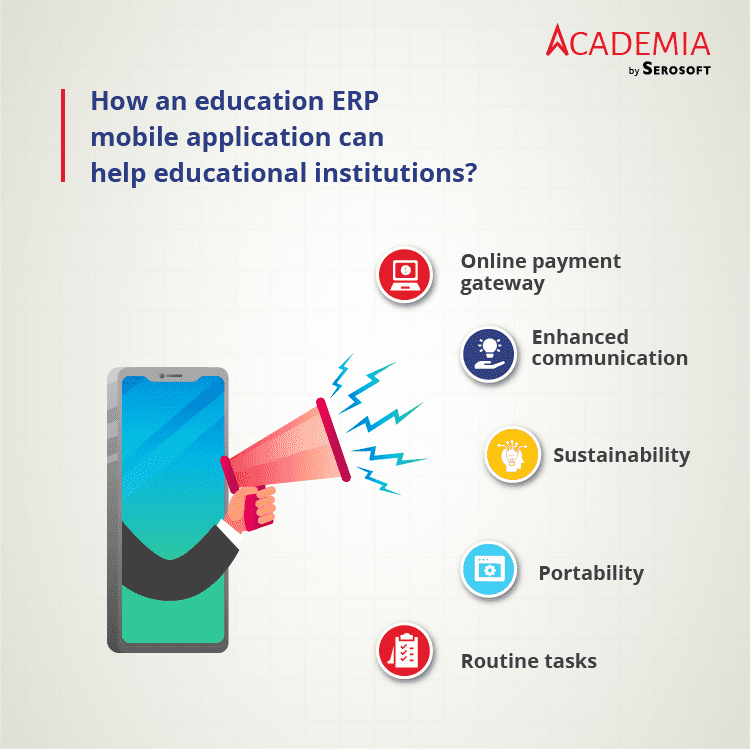
From the last few decades, technological advancement in education has been immense. Education previously was associated with traditional classrooms but with increased use of technology, enhancement in education is being the new trend, one of the most common technology uses in education are mobile applications. An education ERP mobile application can help educational institutions manage and streamline their operations in a more systematic and enhanced manner. 

So what do you know about having a mobile ERP application? Let’s discuss its usage and benefits for the education system. 

Benefits of using a mobile ERP application for the education system

Mobile ERP Application

  • Enhanced Interaction 

Mobile apps associated with an ERP have proved to be the best in increasing the interaction between faculty and students. A robust ERP system provides a mobile app that helps in integrated and enhanced interaction among faculty and students. With an ERP mobile app students get the opportunity to resolve any query anytime with the respective faculty and likewise, the faculty can discuss anything anytime with any student having facilities like messaging and notifications options. Isn’t it awesome? 

  • Increased Communication

Communication is the key factor in any educational institution, it needs to be perfect in both external and internal management. An ERP mobile application provides seamless communication between administrative staff, faculty, parents, and students. It provides all the features updated in a single mobile application that can be used by any educational authority associated with the institution as per their requirements. It gives access to parents to ask and generate any query related to their kids and likewise, teachers and other administrators can solve and ask any questions any time with parents and students using the mobile app. This is so quick and simple! 

  • Efficient administrative management 

In any educational institution, there are multiple administrative tasks from admission, enrollment, fee, hostel, and various others. All the operations must remain systematic and efficient in any manner. With the traditional or manual way of working, all these tasks remain slow, ineffective, and sometimes include various errors, meanwhile, it is important to note that not always manual interventions create ineffective management but we can say it always will remain slow and tedious as expected to digital completion of all these tasks. 

A mobile app integrated with an ERP provides systematic and online management 

of all the operations from admission to alumni of a student, it makes easy management at each end i.e., student, parent, faculty, and the admin staff. Sounds interesting?

  • Systematic academic operation

Academics are all where students get the education and learning in any educational institution. Academic operations like teaching, learning, examination, result declaration, and various other tasks need to be managed effectively and efficiently as they directly affect the education and learning of the students, so for these, educational institutions must opt for software that leads toward effective, efficient, and systematic workings in the institution. Think how easy all these will happen if faculty and students can attain these tasks from their mobile phones, isn’t it easy and flexible? 

A mobile application integrated with an ERP system provides access to all the academic operations on the mobile application, students can easily access the mobile app attaining all the information simply with a few clicks. Starting from the admission of the student, enrollment, classes, examination, results, and even alumni of the student. Everything can be managed using the education ERP mobile application. Ah, amazing!

  • 24/7 availability 

Unlike traditional classrooms, mobile applications provide 24/7 availability, students, faculty, and not even the administrators need to wait for the schedule, a mobile app provides anything, anywhere, and anytime. An ERP mobile application for educational institutions always promotes child-friendly control so that any technical or non-technical person like parents or other staff can easily access it anytime. 

  • Systematic learning process 

Those were the days when students only had access to learning stuff in the classroom, now with the increased technology various online tools can make it systematic with efficient learning like ERP software. An ERP mobile application software provides a systematic learning process making everything easier and accessible for the students and they can attain any study material, can resolve any query anytime, can connect with the faculty using the mobile application. Easy, what do you say?

  • Instant updates 

It is one of the best features of the ERP mobile application, it provides necessary notifications to faculty, students, and parents to complete the operation at its due date. An education ERP mobile application provides notifications to students on the due date of fee submission, admission form filling, examination date, and a lot more, and likewise for faculty, administrators, staff, and even parents. Tremendous faculty, agree?

Wrapping up!

So, what do you think, and education ERP mobile application will help the most for which operation? Let’s have a discussion to make it more relevant. We are one of the leading education ERP software and focus to provide complete digital transformation and automation in educational institutions. Wanna know more? Check Academia now or book your demo!